
Tag: decision making

  • Game Theory and Its Powerful Impact on Strategic Thinking

    Game Theory and Its Powerful Impact on Strategic Thinking

    Introduction

    Game Theory is the science related to strategic thinking and decision-making, developed and categorized by mathematical models, to determine the best possible outcome. Officially developed by John von Neumann and Oskar Morgenstern in the 1940s, these various “games” or strategies had been an integral part of human history since eternity. Game theory outcomes are determined based on the Nash equilibrium, which is a situation in which none of the players can improve their condition through strategic thinking. Here, in this blog post, we are going to discuss four such intriguing games that influence our everyday life directly or indirectly.

    Game 1: Prisoner’s Dilemma

    Suppose there is a robbery in a building. The local police arrested two individuals on suspicion. They are kept in two separate cells with no possible way of interaction between them. Now, the investigating officer went to the individual suspects and gave the following offer. If both confess, they get 3 years of imprisonment. If neither confesses, they get 1 year for a minor crime they committed earlier. But if one confesses and the other doesn’t, the one confessing is immediately released, while the other gets 10 years of imprisonment. So, the following situation arises:
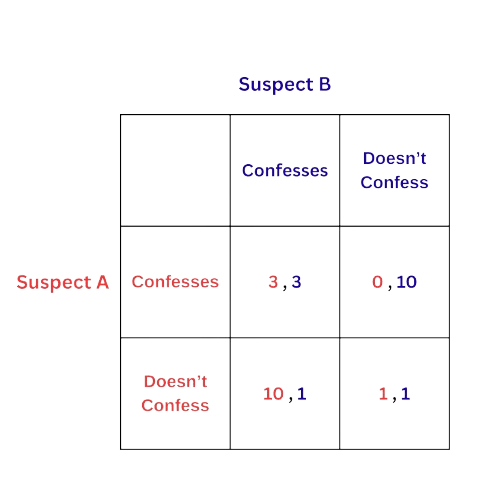
    From the matrix, let us assess the choices available. As they cannot contact each other, they should make choices based on assumptions about the other. So, if we consider that B has confessed, the best decision for A is to confess, as he will serve 3 years of prison instead of 10. Similarly, if B doesn’t confess, A still should confess, as he will be immediately set free instead of serving one year. The situation is the same from B’s side. So, the Nash equilibrium for this game is both confessing and serving 3 years.

    Game 2: Game of Chicken

    In this game, there is not one but two Nash equilibria. Let us consider a situation in which two drivers, A and B, are driving towards each other. They made the agreement that the one who swerves will be labelled a chicken. Now, if none of them swerves, they will crash, leading to serious injury and even death. Let us rate the choices based on the positive outcome. Let injury or death be 0, being called a chicken be 1, while the opponent gets 3, and if nothing happens, each gets 2. We get the following matrix:
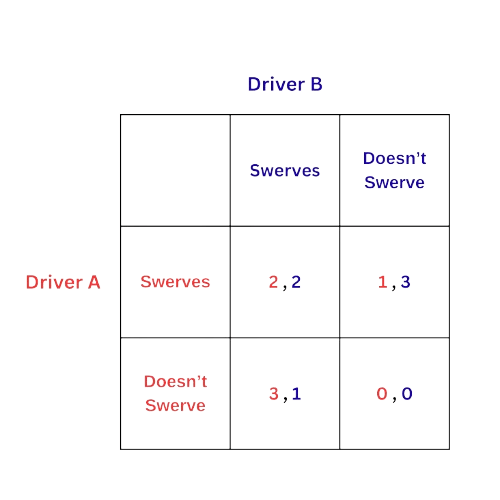
    Game-of-Chicken-Game-Theory

    Now, even though the safest outcome is both swerving, their individual situation can be improved. Also, neither of them swerving could be fatal. Thus, the Nash best outcomes arise when one swerves and the other doesn’t, thus leading to two different Nash equilibria.

    Game 3: Stag Hunt

    This game was devised by the French philosopher, Jean Jacques Rousseau. As per the game, hunters A and B can hunt a stag together, which is a large animal, or can hunt rabbits individually. But group hunting needs trust, as there is a chance of betrayal. So, let us give points to their decision based on the amount of success. If both successfully hunt the stag, we give 10 to each. If they individually hunt rabbits, each gets 2. But if one goes after the stag and the other goes after the rabbit, the one hunting the stag is almost destined to fail and will get 0, while the rabbit hunter gets 4, as he is the only successful hunter. Thus, the following situation arises:
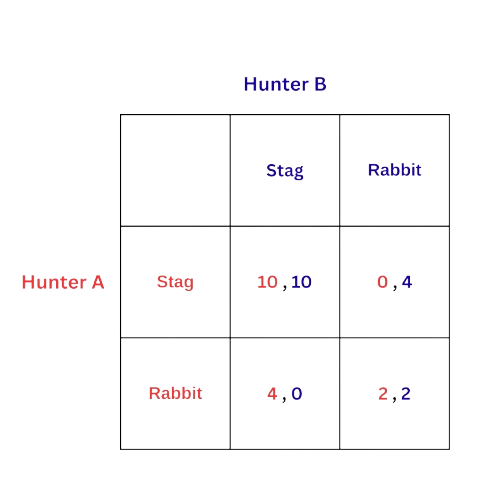
    Stag-Hunt-Game-Theory

    From the matrix, we see that going to hunt stag alone is a very poor outcome, so the hunters have two choices: either to hunt rabbits individually or to hunt stag together, thus giving rise to two different Nash equilibria.

    Game 4: Battle of the Sexes

    Let us consider a couple where the man wants to watch an action movie together, while the woman wants to watch a romantic movie together. In both cases, they prefer watching together over alone. Now we rate their satisfaction levels. If they watch different movies, they both get 0 as they feel lonely. But if both watch the same movie, the person whose preferred movie is chosen is more satisfied and gets 2, while the partner gets 1, as shown in the following matrix:
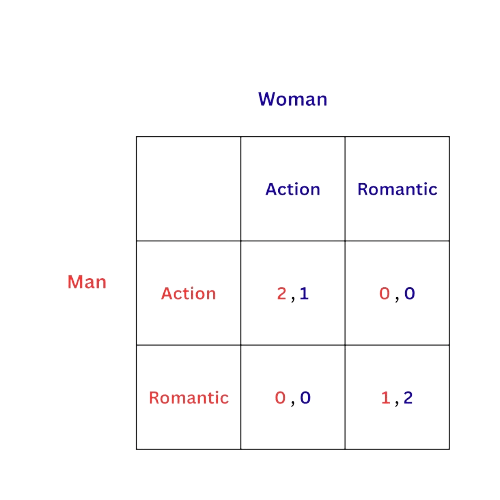
    Battle-of-the-Sexes-Game-Theory

    Thus, here too, there are two equilibria where they watch the same movie.

    Conclusion

    Thus, we see how Game Theory plays an important role in understanding human interactions. Many such games describe many more complex decision-making. Studying these models can help us better understand the strategic thinking of individuals.

    You can also read my original, more detailed article, published in theindicscholar.com, here.
  • Understanding Popular Fallacies and Biases in a Simplistic Way

    Understanding Popular Fallacies and Biases in a Simplistic Way

    Introduction

    We often see a well-educated, rational person making the most illogical decision one could expect. Why does an intelligent human behave in such a baffling way, believing in irrational ideas and indulging in senseless practices? Well, this is due to some hidden glitches that shape critical thinking. Humans take shortcuts, relying on habits and being influenced by emotions. These shortcuts are known as cognitive biases, and the common errors that they make in their reasoning are known as logical fallacies. In this blog posts we discuss the most common fallacies and biases that are very important when understanding the science of the human mind.

    Logical Fallacies

    1. Ad Hominem Fallacy: It is the act of attacking the person making an argument instead of the argument itself. This is often used by desperate people in an attempt to win an argument by questioning the intelligence, ethics, logic, and even the qualifications of the opposition.
    2. Strawman Fallacy: In this error, the person making the fallacy deliberately misrepresents the opponent’s arguments, so that it can be easier to refute. It is a dangerous tool, where the opposition’s argument can be turned into a laughable parody, even if the argument is reasonably sound.
    3. False Dilemma: This fallacy happens when only two options are presented as the only possible solutions, although many more options exist, leading to a false dichotomy of choice.
    4. Circular Reasoning: It is the error when one person claims that A is because of B, and B is because of A, thereby repeating the same argument again and again without progressing to any conclusion.
    5. Appeal to Authority: Here, a person argues that something is true because an authority on that matter says so, however illogical it may sound. It is a very common fallacy used especially in academic and professional circles.
    6. Appeal to Emotion: When a person tries to win an argument by manipulating emotions instead of logic and facts, the fallacy is called appeal to emotion. Here, the person using the fallacy may play the victim, thereby gaining the audience’s sympathy through emotions.
    7. Bandwagon Fallacy: When a person believes or does something because everyone else believes or does so, it is known as bandwagon fallacy. Here, the person joins the bandwagon of the contemporary practice and even defends it without any logic or reason.
    8. Red Herring: It is the act of diverting attention from the topic to a totally irrelevant topic. It is named after the Red Herring fish, whose odor can distract even a well-trained bloodhound.

    Cognitive Biases

    1. Confirmation Bias: It is the act of seeking information that supports one’s existing beliefs, while neglecting all the information that goes against it. We often make this bias intentionally or unintentionally.
    2. Anchoring Bias: When a person relies on or anchors on the first piece of information to judge or perceive other information, this bias is called anchoring bias.
    3. Negativity Bias: In this bias, a person only focuses on the negative experiences over a certain topic, even though similar or more positive experiences are reported from the same topic.
    4. Halo Effect: When one positive trait influences the perception of all other negative traits, the bias is known as the Halo effect. For example, in movies, we generally have an attractive lead, thereby creating the bias that all attractive individuals are good at heart.
    5. Status Quo Bias: This bias is created due to the tendency to prefer things to remain the same forever, even if they are harmful, as the person with the bias has already become habituated with that.
    6. Recency Bias: A very popular bias, this act occurs when one gives importance to recent events over older ones, even if they deserve more importance.
    7. Illusory Correlation: It is the tendency to see connections between two independent events, even if they are totally unrelated.
    8. Authority Bias: Similar to appeal to authority, this bias happens when we blindly believe someone about a topic, as the person is considered an expert in the field. We give preference to the authority over our reason in believing the person’s words or acts.

    Conclusion

    Human behavior is a very exciting and intriguing topic. And interestingly, the so-called most intelligent species makes its decisions clouded by fallacies and biases. True intelligence isn’t about never being wrong. It’s about knowing when our brain is fooling us and daring to question it.

    References

    You can also read my original blog post published in theindicscholar.com by clicking here.