Introduction
A code is a set of words, figures, letters, numbers, or symbols generally used to represent a secret message that can be understood only by a specific group of people across distance and time. Mankind has been using secret codes and signs since the prehistoric era. In this blog post, we discuss the evolution of these codes and encryptions, starting from the Mesopotamian tablets to modern quantum cryptography.
Chapter 1: Mesopotamian Tablets (~1500 BCE)
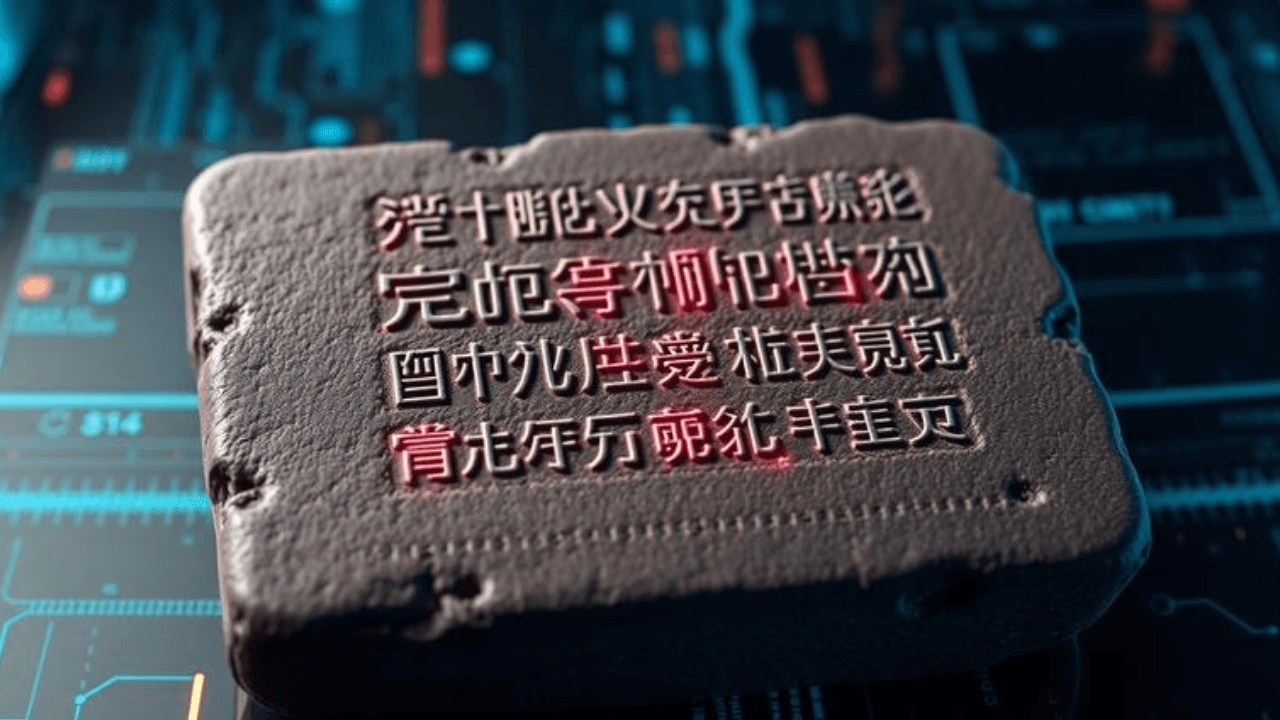
The Mesopotamians were the first to use some kind of encryption in the known recorded history. The most famous example is the clay tablet from 1500 BCE, where a cryptographic formula for making pottery glaze was embedded. The scribes intentionally altered some words and signs to preserve knowledge from foreign or unworthy people.
Chapter 2: Egyptian Hieroglyphic Ciphers (~1500 BCE)
The ancient Egyptians used idiographic and iconographic hieroglyphs to preserve political and religious texts on papyrus and wood. The tombs of the Pharaohs had unusual and rare hieroglyphs preserving rituals for funerary rites that were limited only to the scribes and the royals.
Chapter 3: The Spartan Scytale (~400 BCE)
In the ancient Greek world, especially in Sparta, a tool called Scytale was used to pass hidden messages. It was a leather strip wound around a cylinder. The message was written on the strip in a unique way. Suppose a cylinder allows writing four letters around its diameter, and five letters downwards along its height. If the message to be sent is “The soldiers are coming”. It can be written as:
| T | H | E | S | O | The end of the Strip | |
| The start of the Strip | L | D | I | E | R | |
| S | A | R | E | C | ||
| O | M | I | N | G |
Thus, the strip when wounded will read as TLSOHDAMAEIRISEENORCG, thus concealing the message.
Chapter 4: Kautilya’s Arthashastra (~300 BCE)
The Indian political genius Chanakya, also known as Kautilya, in his text, “Arthashastra,” stated the art of understanding codes called “Mlecchita Vikalpa (Secret Writing). In this code, the short and the long vowels, the anusvara, and the spirants were interchanged with consonants and the conjuncts of the royal script, creating encryptions only known by the royal intelligence and spies.
Chapter 5: Caesar Cipher (~58 BCE)
Named after the Roman general, Gaius Julius Caesar, in this cipher, each letter is substituted by another letter with some fixed number of positions down the alphabet. It is one of the most well-known ciphers and is still used today.
Chapter 6: Al-Kindi’s Cryptanalysis (~950 CE)
The Arab polymath al-Kindi was the pioneer of cryptanalysis and is credited with developing a method of observation and study of the frequency of occurrence of letters, thus enabling the cipher to be decoded. He described this process of cryptanalysis in his book, “Risala fi Istikhraj al-kutub al-Mu’ammmah (On Extracting Obscure Correspondence).
Chapter 7: Vigenere Cipher (~1550 CE)
The Vigenere Cipher, described by G.B. Bellaso and Friedrich Kasiski, was an improvement upon the Caesar Cipher, where the increment was determined by the corresponding letter of another text, called the key. So, only the person having the key could decipher the code. This created a revolution in modern cryptography.
Chapter 8: One-Time Pad (~1920 to Present)
The One-Time Pad (OTP) is an encryption technique that cannot be deciphered if done correctly. It uses a single-use pre-shared key that is larger than the actual data. The data is encrypted and cannot be decoded as long as the key is larger than the text and keeps changing randomly after each trial.
Chapter 9: The Enigma Machine (~1920 – 50)
It was a cipher device developed by the Nazi Party. It had an electromechanical motor scrambling the letters of the alphabet. The system used illuminating lights as the key for deciphering the codes. It was used by them in World War II until it was finally cracked by the British scientist, Alan Turing, and his team.
Chapter 10: Quantum Cryptography (1984 – present)
In this case, several quantum mechanical properties are used for cryptography. One feature of it is the Quantum Key Distribution (QKD), which allows two parties to share a secret key. If any third party tries to interfere, its defense function will destroy the process and reveal the spy. Countries like the US, China, and India are experimenting with satellite-based QKD to secure national information.
Conclusion
Cryptography and cryptanalysis have evolved over the past four thousand years in a very cinematic way. Each type of code has its own story: sometimes sending secret information, while sometimes preserving valuable information. The history of cryptography shows that while the process evolves, the destination remains the same.
You can read the original blog post published by me in theindicscholar.com here.